From 'What Is Happening' to 'What May Happen Next': When Patient Monitoring Starts to Predict
Most of us check the weather in two ways. Sometimes we look out of the window to see whether it is raining. Other times we check the forecast, because what we want to know is whether we will need an umbrella later. Hospital monitoring has mostly worked like the window. A bedside monitor, or a nurse taking observations, tells the care team what a patient's heart rate, breathing, oxygen level and blood pressure are right now. That information is essential, but it answers a narrower question...
Sabapathy J
3 min read
Patient Monitoring Technology
Most of us check the weather in two ways. Sometimes we look out of the window to see whether it is raining. Other times we check the forecast, because what we want to know is whether we will need an umbrella later.
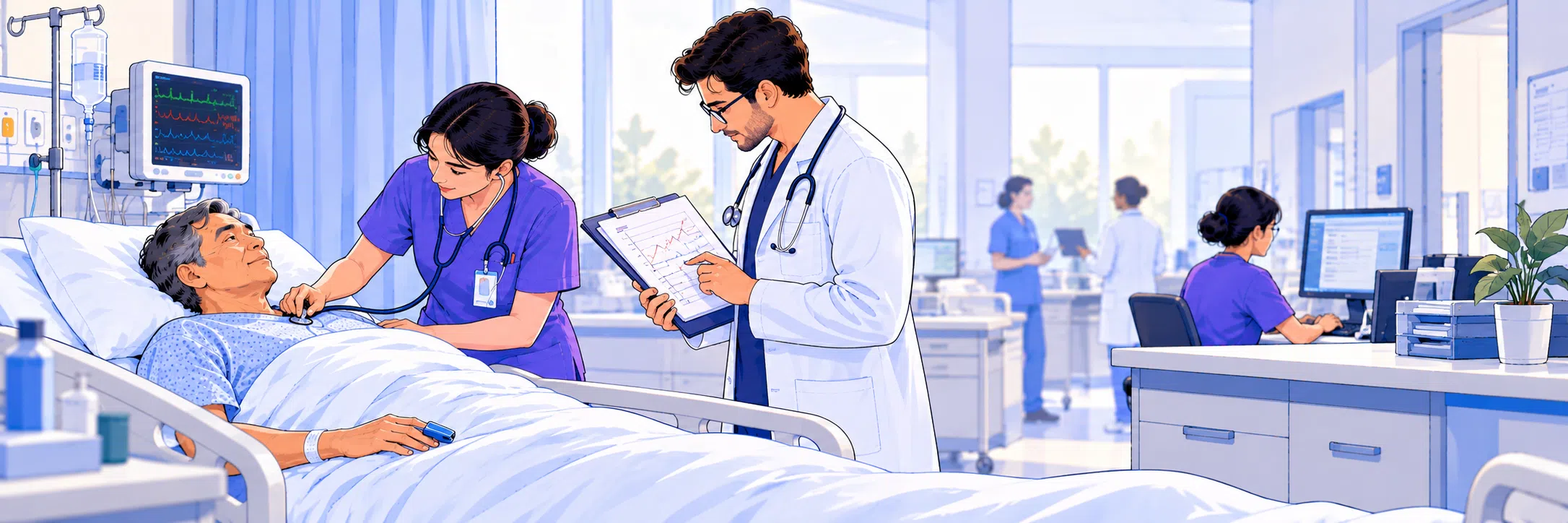
Hospital monitoring has mostly worked like the window. A bedside monitor, or a nurse taking observations, tells the care team what a patient's heart rate, breathing, oxygen level and blood pressure are right now. That information is essential, but it answers a narrower question than the one care teams care about most: is this patient getting worse, and who is likely to need us next?
What conventional monitoring is built to answer
Traditional monitoring works with limits. Each measurement has a safe range, and when a reading goes outside it, an alarm sounds or a score goes up. That approach is good at confirming that something has already gone wrong.
The weak point is timing. Many patients who deteriorate do not cross a line all at once. In a study of 64 patients who had a cardiac or respiratory arrest in one US hospital, 84 per cent had documented signs of deterioration or new complaints in the eight hours before the arrest. The warning signs were present, and in many cases already recorded, hours before the arrest itself.
What changes when monitoring estimates risk
Predictive monitoring asks a different question. Instead of "is this number outside its range?", it asks "given how this patient's readings are changing, is their risk going up?"
To answer that, the system looks at the patient's own pattern rather than single readings: a heart rate creeping up over several hours, breathing getting a little faster, oxygen levels that dip, recover and dip again. Each change may look minor on its own. Read together, and alongside other information such as lab results where they are available, they can show a patient heading in the wrong direction.
The result is an estimate of changing risk, not a diagnosis. It helps a team decide where to look first, which matters most when one nurse is looking after many patients at once.
What prediction does not do
A predictive system does not decide treatment. It does not replace the nurse who senses a patient is unwell, or the doctor who examines them. It gives that team more time and a clearer sense of who to see first, so a patient can be reviewed, watched more closely or passed to a senior doctor while more options are open.
Explanation matters as much as the prediction. Clinicians are more likely to act quickly on an alert when they can see which changes lie behind it.
How prediction works inside Lifesigns Nexus
At Lifesigns, data from wireless, wearable devices and compatible bedside equipment flows into Lifesigns Nexus, the platform where each monitored patient's readings come together. The AI engine built into Nexus reads each patient's vital signs as they change, including small shifts that are easy to miss, and places the patient in one of four risk categories, from Standard Care for patients who appear stable to Resuscitation for those who need urgent attention. Alongside the category, it shows the reasons, so the team can see why a patient has moved up.
In the groups of patients where Lifesigns has measured it, this kind of analysis has typically given three to six hours of advance warning, and one pilot recorded an average of about 172 minutes. In one set of ward patients, the AI picked up around 99.3 per cent of sustained deterioration episodes. These numbers describe those particular patients rather than a promise for everyone, but they show what monitoring can do once it looks ahead as well as at the present.
Present readings will always matter. What is changing is that the same readings can now tell a care team which patients may need them next, while there is still time to act.