Vital Signs Are Checked Every Few Hours. Patients Don't Change on That Schedule
Nobody chose four-hourly observations because patients deteriorate every four hours. On most hospital wards, nurses check patients' vital signs at regular intervals: heart rate, breathing rate, blood pressure, oxygen level and temperature. These checks are usually called observations. Depending on the hospital and the patient, they might happen every four, six or twelve hours. Those schedules are sensible. But they were designed around what a ward can realistically manage, not around how...
Sabapathy J
3 min read
Nobody chose four-hourly observations because patients deteriorate every four hours.
On most hospital wards, nurses check patients' vital signs at regular intervals: heart rate, breathing rate, blood pressure, oxygen level and temperature. These checks are usually called observations. Depending on the hospital and the patient, they might happen every four, six or twelve hours.
Those schedules are sensible. But they were designed around what a ward can realistically manage, not around how quickly a patient's body can change.
Where observation schedules come from
Guidance sets a minimum. In the UK, NICE guidance on acutely ill adults in hospital states that physiological observations should be monitored at least every 12 hours, with the frequency adjusted for individual patients.
In practice, the schedule on any ward is shaped by staffing. One nurse may be responsible for many patients. Each full set of observations takes several minutes. Add medication rounds, admissions, discharges and paperwork, and there is a limit to how often every patient can be checked.
Nurses are not cutting corners. It reflects a system built around what can be done by hand. Night shifts add another layer: staffing is often thinner, and teams may space out checks so that patients can sleep.
What happens between the checks
The body does not follow the schedule. Oxygen levels can drop and recover. Heart rhythm can change for a few minutes and return to normal. Breathing can speed up gradually through the night.
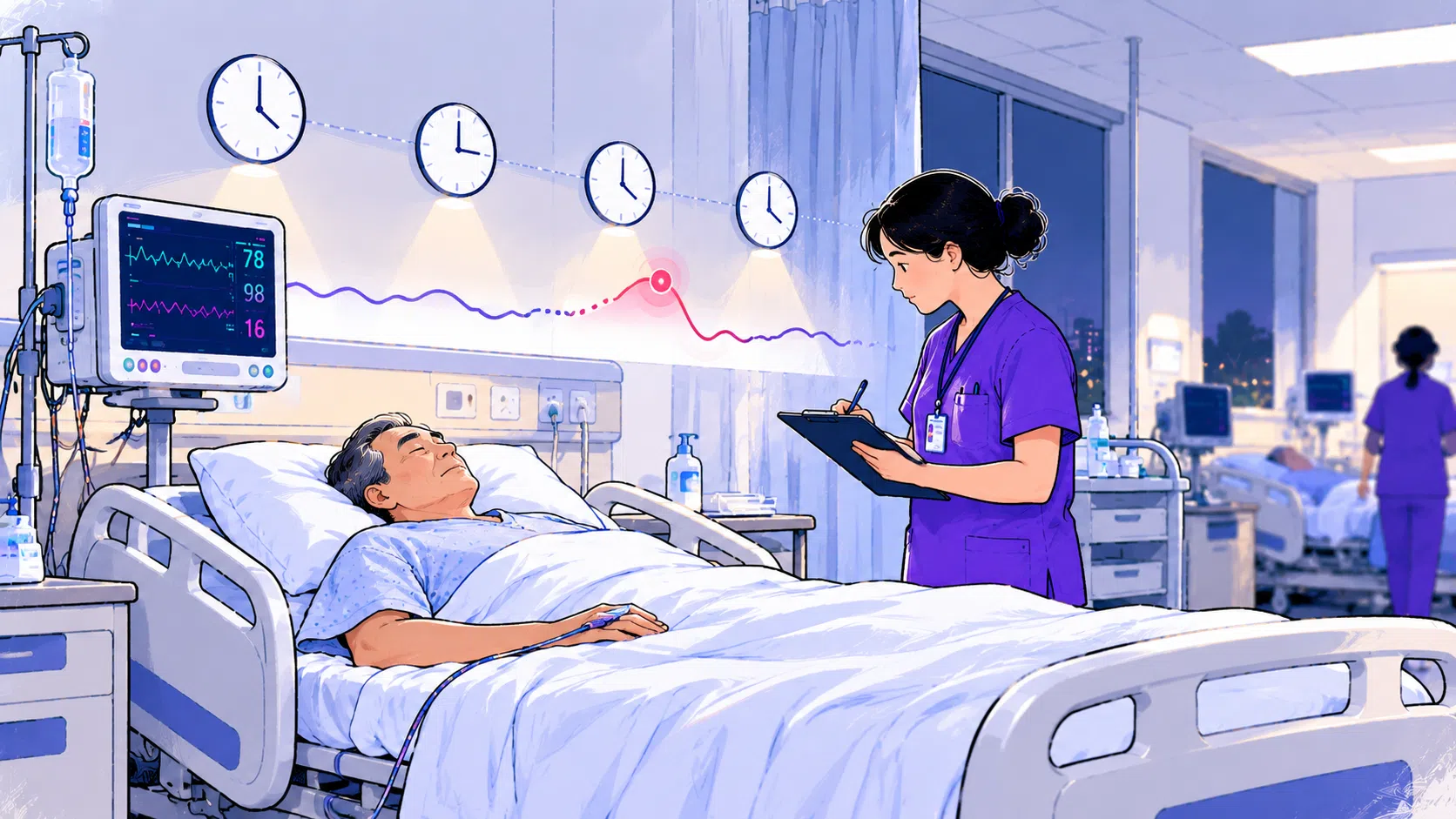
If one check happens at midnight and the next at 4 AM, anything in between is invisible unless the patient or a relative raises it, or a nurse happens to notice. A patient can look stable at both checks and still have spent part of the night in difficulty.
A line instead of dots
Continuous patient monitoring changes the shape of the information. Instead of a few dots on a chart each day, the team sees a line.
That line shows direction. It shows whether a patient's heart rate has been rising since the afternoon, whether their oxygen dipped overnight, or whether their breathing has settled after treatment. It fills the gaps between checks instead of adding more checks.
Does continuous mean more work?
Nursing teams often worry that continuous monitoring will bring more alarms and more work. It can, if every small change sets off an alert.
What makes the difference is how the information is handled. Lifesigns Smart Monitoring, which uses wireless, wearable devices to monitor patients continuously on hospital wards, is built around that problem. The readings go to Lifesigns Nexus, which shows the ward team all its monitored patients on one screen. There, the team can set alert limits for each patient, alerts about the patient are kept separate from technical ones such as a loose sensor, and the NEWS2 warning score can be worked out automatically when the readings it needs are available. Its built-in AI orders patients by how their risk is changing, which helps the team decide who to see first. Where a hospital chooses, a Central Monitoring Team of trained staff watches the data around the clock and alerts the ward only when agreed limits are crossed.
Handled that way, continuous monitoring can save time rather than add to it. In a workflow analysis Lifesigns refers to, it was linked to more than 10 nursing hours saved each day on a 30-bed ward.
A ward does not become an ICU, and observation rounds will stay, because they bring a nurse to the bedside and that matters in its own right. Continuous monitoring adds what rounds cannot: a clear view of the hours in between, including the ones in the middle of the night.