Patients Rarely Get Worse All at Once. The Signs Usually Build Over Hours
When a patient's condition gets worse in hospital, it can look sudden from the outside. One moment the patient seems settled. The next, an emergency team is at the bedside. Looking back, the change often started hours earlier as a series of small shifts all heading the same way. That pattern is one of the most useful things to understand about patient safety. Why single readings can mislead Most hospital checks are snapshots. A nurse records heart rate, breathing rate, oxygen level, blood...
Sabapathy J
3 min read
Patient Monitoring Technology
When a patient's condition gets worse in hospital, it can look sudden from the outside. One moment the patient seems settled. The next, an emergency team is at the bedside.
Looking back, the change often started hours earlier as a series of small shifts all heading the same way. That pattern is one of the most useful things to understand about patient safety.
Why single readings can mislead
Most hospital checks are snapshots. A nurse records heart rate, breathing rate, oxygen level, blood pressure and temperature, and each value is compared with a normal range. If everything sits inside those ranges, the patient is usually treated as stable until the next check.
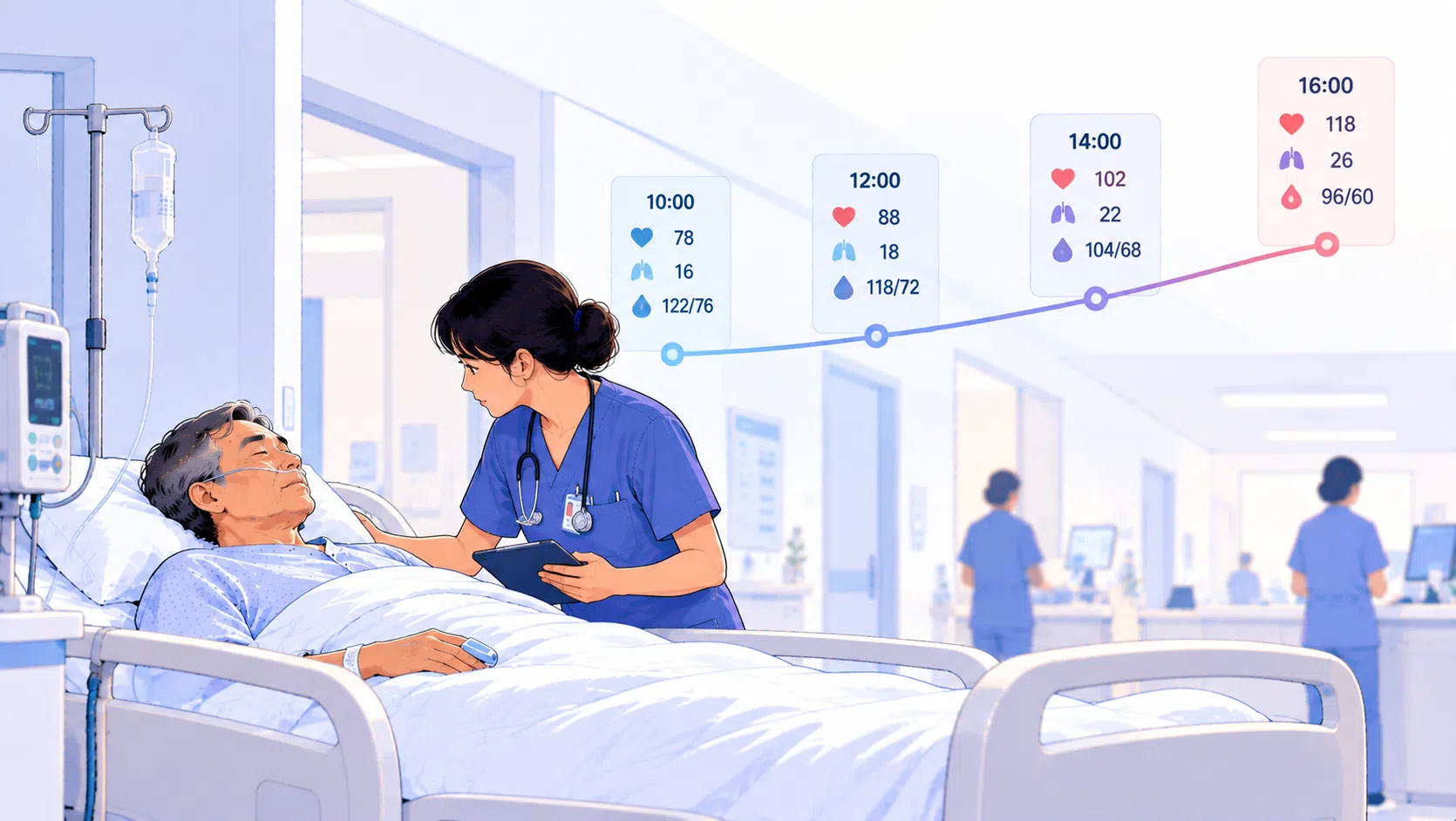
A reading can be normal and still be moving, though. A heart rate of 98 is within range. So is 88. But if a patient was at 88 in the morning and 98 by the afternoon, the change tells a different story from either number.
How the body hides early trouble
The body is good at compensating. When something starts to go wrong, such as an infection, bleeding or a breathing problem, it adjusts to protect blood pressure and oxygen supply. The heart beats a little faster and breathing speeds up. For a while, those adjustments keep the headline numbers looking acceptable.
That is why getting worse so often shows up first as a trend. In a study of 64 patients who went on to have a cardiac or respiratory arrest in a US hospital, 84 per cent had documented signs of deterioration or new complaints within eight hours of the arrest, most often involving their breathing or mental state.
Breathing rate is a good example of an early signal that is easy to miss. A review in the Medical Journal of Australia called it the neglected vital sign, citing a hospital where only 30 per cent of ward patients had their breathing rate recorded each day before an early warning system was introduced.
What it looks like for a real patient
One of Lifesigns' case reports shows how this unfolds. A 65-year-old woman with Crohn's disease, a long-term bowel condition, was under continuous monitoring in a general medicine ward. At 2:29 PM on 28 August 2025, monitoring picked up frequent ventricular ectopics, a kind of irregular heartbeat, with a heart rate of 107 beats per minute. The event was escalated, a physician was consulted and medication was started to settle her rhythm.
At 12:16 AM on 29 August 2025, her blood pressure fell to 81/57 mmHg. The medical team was alerted again and started intravenous fluids, and her blood pressure stabilised. According to the case report, she did not need to move to the ICU.
Neither event tells the whole story. Together they show a patient whose condition was shifting over about ten hours, including a change after midnight, when ward checks are often further apart.
Watching the direction, not only the limits
Seeing that direction takes three things. Readings have to be collected continuously, not every few hours. They have to be shown as a trend, so the team can see where a patient has been as well as where they are now. And something has to help the team spot the trends that matter across many patients at once.
That last part is where AI helps. At Lifesigns, continuous readings flow into Lifesigns Nexus, where the ward team can follow each patient's readings over time. Its built-in AI looks at how those readings are moving together and estimates whether the patient's risk is rising. In the groups of patients Lifesigns has studied, it has typically picked up rising risk three to six hours ahead. What to do about it stays with the clinical team; the aim is to show them which way a patient is heading while there is still time to respond.
A single check tells you how a patient is right now. A trend tells you where they are going, and most deterioration shows its direction long before it becomes an emergency.