Why a Patient's Information Should Follow Them Across the Entire Patient Journey
A patient can meet five different teams. Each of them, to some extent, starts from the beginning. Take a man who becomes unwell at home with chest pain and breathlessness. An ambulance crew looks after him on the way to hospital. The emergency room assesses him and decides he needs intensive care. After two days in the ICU he improves and moves to a general ward. A week later he goes home. That is five settings, several teams and many handovers. Everyone caring for him is skilled and careful....
Sabapathy J
4 min read
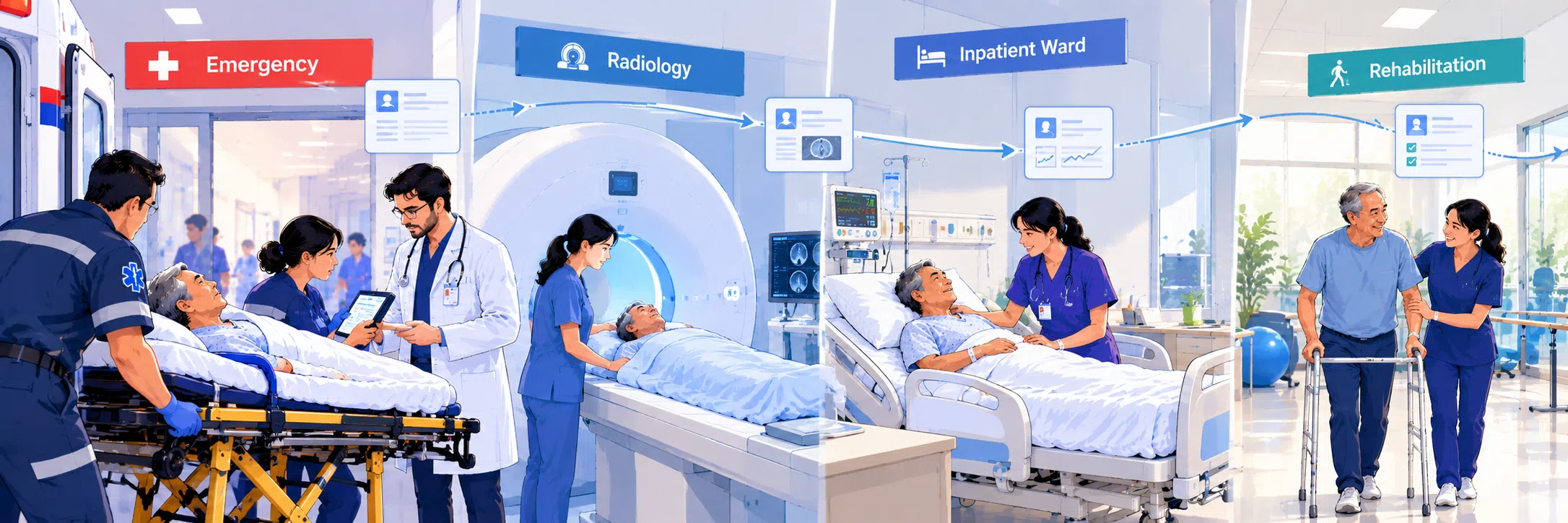
A patient can meet five different teams. Each of them, to some extent, starts from the beginning.
Take a man who becomes unwell at home with chest pain and breathlessness. An ambulance crew looks after him on the way to hospital. The emergency room assesses him and decides he needs intensive care. After two days in the ICU he improves and moves to a general ward. A week later he goes home.
That is five settings, several teams and many handovers. Everyone caring for him is skilled and careful. Yet every move carries the same risk: some of what the last team learned does not arrive with him.
What gets lost at each handover
Handovers are one of the best-known weak points in healthcare. In 2017 the Joint Commission, which accredits hospitals in the United States, issued a safety alert on poor handover communication, setting out how gaps at handover contribute to serious harm and what hospitals can do about it.
Part of the problem is that what gets passed on is usually a summary. The emergency room hears what the ambulance crew remembers. The ICU gets the main findings from the emergency room. The ward gets a transfer note from the ICU. Each summary is useful, but it describes where the patient is, not how he got there.
That missing history matters. A heart rate of 100 means one thing in a patient whose rate has been falling from 130, and something quite different in a patient whose rate has been climbing from 70.
Following the same patient, stage by stage
Using the Lifesigns approach as an example, this is how the same journey looks when the information travels with him.
In the ambulance, Lifesigns Smart Ambulance monitors his heart rhythm and vital signs and sends them ahead to Lifesigns Nexus, the platform the hospital uses to follow its patients from the ambulance through to discharge. The emergency team watches his journey before he arrives.
In the emergency room, monitoring continues while he is assessed and waits for a decision. Nexus's built-in AI weighs how his readings are moving and gives him a risk category, with its reasons, which helps the team decide how quickly he needs to be seen.
In intensive care, Lifesigns Connected ICU links the machines around his bed, such as monitors, ventilators and pumps, into one view. His earlier trends from the ambulance and emergency room are already there.
On the ward, Lifesigns Smart Monitoring keeps tracking him through wireless, wearable devices, so a change in direction is visible straight away instead of at the next routine check.
At home, Lifesigns At Home lets his hospital keep an eye on his vital signs remotely after discharge, if his doctors decide it is right for him.
Not every patient goes through every stage, and the ICU is only for those who need it. Whichever path a patient takes, the aim is the same: each new team sees more than a fresh snapshot.
Continuity does not mean identical monitoring
Keeping information together does not mean monitoring a patient the same way everywhere. An ambulance, an ICU and a living room are very different places with different equipment.
What can stay constant is the information that helps the next team understand the patient: how their vital signs have moved, their risk category, any alerts and what was done about them, their medicines, their test results and anything important that happened earlier.
Where AI fits
AI becomes more useful with a longer view. An estimate of a patient's risk on the ward is better informed if it can take account of what happened in the emergency room and the ICU, and when it shows its reasoning, a new team can see why a patient is being watched.
AI can also take some of the work out of handover. Summaries, trend reports and discharge documents can be put together from information already recorded, then checked and approved by clinicians, instead of written from memory at the end of a long shift.
Patients will always move and teams will always change. What does not have to happen is the patient's story starting again at every door. When the information follows the patient, every team can pick up where the last one left off.