A Patient Can Run Low on Oxygen Between Two Normal Readings
Two oxygen readings, four hours apart, can both be normal. The line between them is not necessarily flat. Oxygen saturation, often written as SpO₂, estimates how much of the blood's haemoglobin is carrying oxygen. It is measured with a small clip on the finger or a similar sensor, and in most healthy adults it sits in the mid to high nineties. When it falls lower, the body may not be getting enough oxygen. Doctors call this hypoxemia. You might expect low oxygen to be obvious: a patient short...
Sabapathy J
3 min read
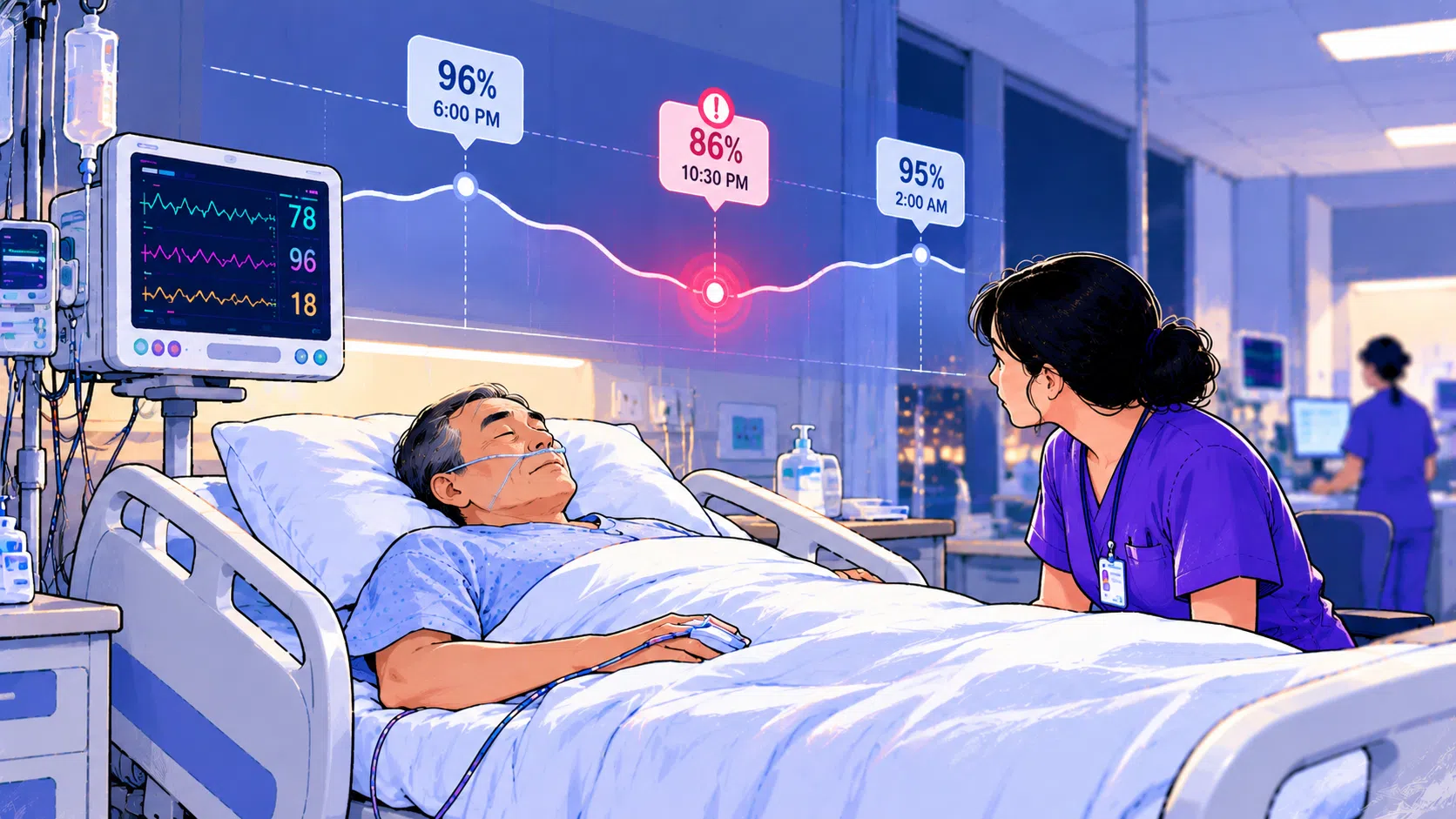
Two oxygen readings, four hours apart, can both be normal. The line between them is not necessarily flat.
Oxygen saturation, often written as SpO₂, estimates how much of the blood's haemoglobin is carrying oxygen. It is measured with a small clip on the finger or a similar sensor, and in most healthy adults it sits in the mid to high nineties. When it falls lower, the body may not be getting enough oxygen. Doctors call this hypoxemia.
You might expect low oxygen to be obvious: a patient short of breath, struggling, calling for help. Sometimes it is. Often it is not.
Why low oxygen can be silent
Many patients with low oxygen levels show few outward signs. Older patients, people recovering from anaesthesia and those taking pain medicines that dampen breathing may not feel or show breathlessness. During the COVID-19 pandemic, physicians wrote about how often patients had very low oxygen levels without appearing distressed, which became known as silent hypoxemia.
That makes hypoxemia hard to catch by looking alone. If a patient does not seem unwell, there is no obvious reason to check them between scheduled rounds.
What routine checks can miss
One study made the gap very clear. Researchers at a US hospital continuously monitored oxygen levels in adults recovering on wards after non-cardiac surgery, without showing the readings to the care team, and compared them with routine nursing checks. Prolonged low-oxygen episodes turned out to be common, and routine vital-sign checks missed most of them.
That study looked at surgical patients, and its findings belong to that group. The underlying reason applies more widely, though. If oxygen levels can fall and recover between checks, a schedule of checks will not see the fall.
What the case files show
Lifesigns Smart Monitoring uses wireless, wearable devices to track patients' oxygen levels and breathing continuously on hospital wards. The readings appear in Lifesigns Nexus as trends the ward team can scroll back through, and alerts go to the clinical team when something changes. Lifesigns' case reports include many episodes of low oxygen caught this way. Two show how different the patients can be.
A man in his eighties with diabetes and heart disease, who had previously had bypass surgery, was admitted with a chest infection. At 7:06 PM on 18 July 2025, continuous monitoring showed his oxygen level had fallen to 86 per cent, with his breathing rate up to 27 breaths per minute. He was escalated to the medical team and given oxygen at 4 litres per minute. According to the case report, he stabilised without needing to move to the ICU.
The second patient was not on a lung ward at all. A 61-year-old woman with chronic kidney disease was being treated in urology for a serious infection called urogenital gangrene. At 9:30 AM on 15 September 2025, monitoring detected a heart rate of 136, a breathing rate of 43 and an oxygen level of 82 per cent. She was escalated, given oxygen and, when she did not stabilise, moved to the ICU for more intensive care.
Low oxygen is not only a problem for people with lung disease. It can come with infection, heart problems, fluid imbalance and many other conditions, on any ward.
Oxygen and breathing together
Continuous oxygen monitoring is most useful alongside breathing rate. A rising breathing rate often shows the body working harder to keep oxygen levels up before they fall. Watching both gives an earlier and clearer picture, and shows whether a dip is brief and recovers or keeps coming back.
Two normal readings can still hide a difficult afternoon. Continuous monitoring shows what happened in between.